

Custom Table Top to Fit My Existing Base UK: What You Need to Measure
How do I measure my existing base to order a custom table top in the UK?
To order a custom table top that properly fits your existing base, you need to identify your base type, measure its footprint, check mounting points, determine ideal overhang, consider thickness, allow for wood movement, and review all measurements before ordering. Accurate information at each step ensures both functionality and comfort.
Table of Contents
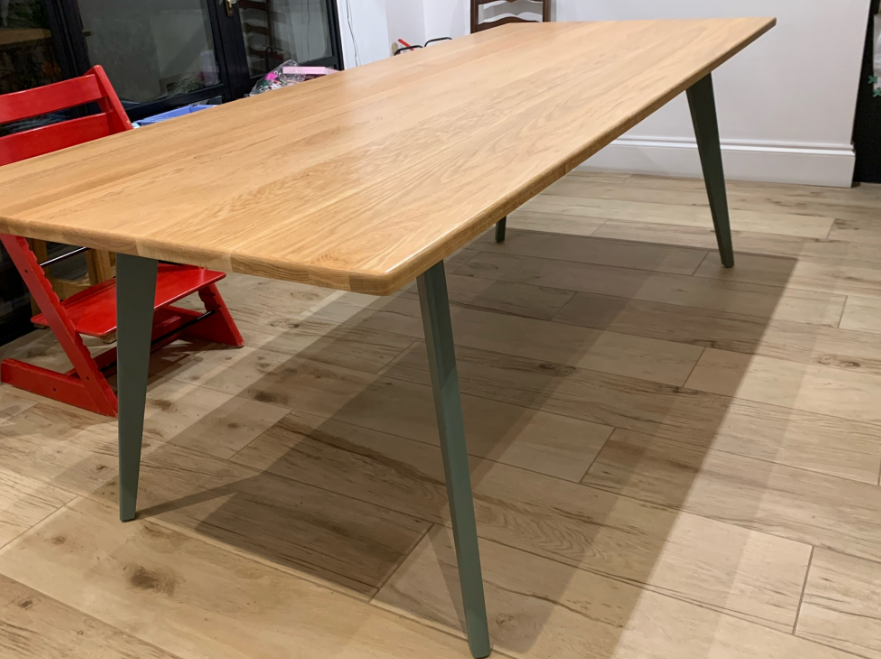
Identify the Type of Base You’re Working With
Not all table bases support tops in the same way. Before measuring anything, it is important to understand what type of base you have, since its form and support points will directly affect the dimensions and mounting details of the new top.
Here are some common base types and what to look for:
Pedestal Base A single central column, sometimes with feet extending outward. These rely on a well-balanced top and benefit from an even weight distribution. Overhang should be carefully balanced to avoid tipping.
Four-Leg Base Each corner has an individual leg. Support points are usually predictable, but matching the shape and proportion is important to ensure both balance and comfort.
Trestle Base Consists of two or more support points connected horizontally. Trestle bases often accommodate longer tops and are common in shared or bench-style seating arrangements. Mounting is typically done through the rails.
Metal Frames (including Sit-Stand Mechanisms) Often adjustable and sometimes lacking standard fixing points. These frames may require measuring bracket positions and confirming alignment. Cable clearance, lifting movement, and motor housing all affect compatibility.
Vintage or Modified Bases Older bases may use non-standard joinery or have previously attached tops permanently altered. Look for existing fixings, potential warping, or irregular mounting locations.
If the base shows signs of instability, warping or significant rust, it may not be suitable for reuse without restoration.
Measure the Overall Footprint of the Base
The footprint is the width and depth of your base as it sits on the floor. This determines the minimum size your new table top should be to ensure aesthetic balance and safe use.
Follow this practical measurement process:
- Use a tape measure to record the widest point from side to side (width).
- Measure front to back across the deepest support points (depth).
- If the base has curved or angled legs, confirm where the top begins to taper and measure slightly beyond to avoid underestimating the footprint.
The finished top should typically exceed the base by a modest overhang on each side. For dining and shared desk use, an overhang of 20 to 30 cm per side is standard. On narrow or wall-facing bases, smaller overhangs down to 10 cm may be preferred. The idea is to ensure comfort without making the top feel disconnected from its base.
Avoid the common mistake of measuring only the frame edges or legs. It is the outer support points that matter most for top stability.
Pro Tip: When working with metal frames, photograph bracket locations before measuring so you can double-check positions later.
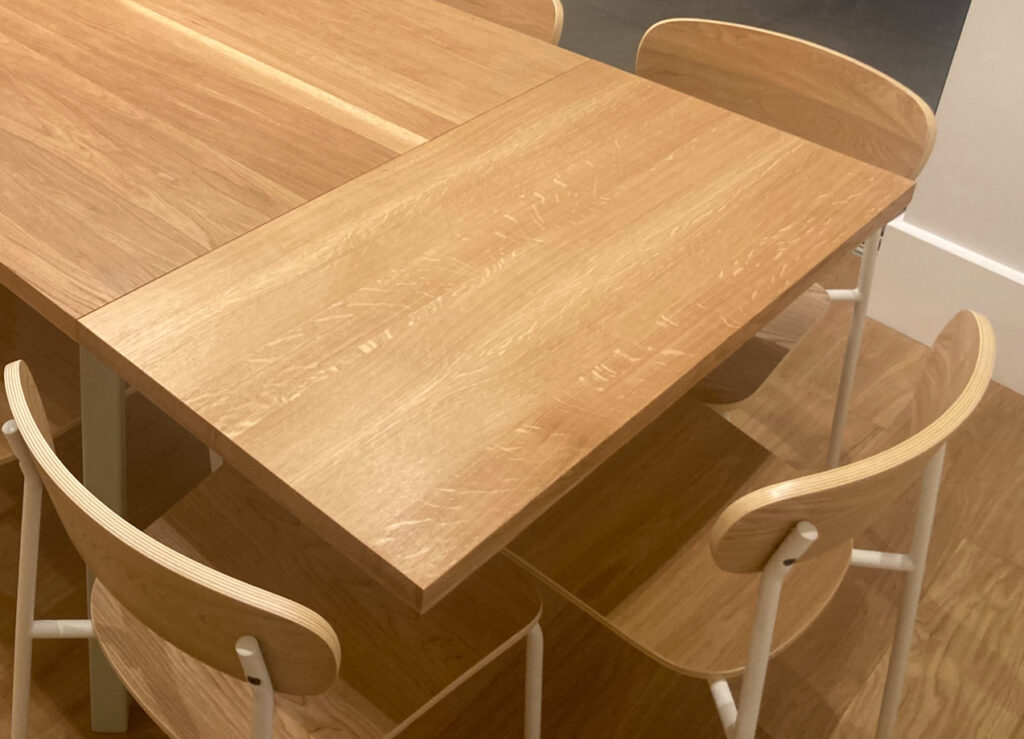
Pro Tip: For vintage bases, lightly sand fixing areas to check for hidden screw holes or non-visible mounting wear.
Check for Mounting Points or Fixing Requirements
Once the dimensions are set, it is important to consider how the top will attach to your base. Without a proper fixing plan, movement over time could damage joints or reduce comfort.
Check the following:
- Are there existing fixing points? Look for brackets, slot systems, or screw plates.
- Is the frame adjustable or moving? Sit-stand bases, in particular, require attention to bracket alignment, wire clearance and lift range.
- Is the underside of the top flat and accessible? Tablemaker supplies tops undrilled by default, which means they can be matched to almost any base with suitable clearance and flat mounting planes.
- Measure bracket lengths and spacing. If your frame has pre-set bracket holes, record their position, both width and depth, so they can align with either drilled holes or allow for safe screw placement.
- Are straightening bars or battens needed? Some larger tops need additional structure on the underside to prevent warping. These are usually compatible with most bases but may affect how fixings are applied.
If your base has no fixing points, the table top must be attached through new brackets or grip pads. In either case, ensure a secure but flexible fit that allows for natural wood movement.
Determine Ideal Overhang for Function and Comfort
Overhang affects much more than appearance. It defines how people sit, move and use the table over time. A good overhang provides legroom, ergonomic comfort and visual proportion.
Here are typical overhang ranges based on use:
Dining Tables Aim for 25 to 30 cm of overhang on all sides. This allows for seating comfort without exposing guests to table legs or encroaching supports.
Desks and Work Tables Front edges usually benefit from 10 to 20 cm of overhang to prevent bumping knees on crossbars. Minimal overhang at the rear can help with cable management or monitor stands.
Benches Match the overhang to user height and base width, typically 5 to 10 cm. Too much overhang risks balance shifts or instability.
Shared Workspaces Where people move between seats or use the surface collaboratively, reduce side overhang for ease of movement, but maintain at least 20 cm at the front for comfort.
Flush or minimal overhang may suit modern or compact spaces but should be planned carefully to avoid visual imbalance or reduced comfort.
Order Your Custom Table Top
Get a bespoke top made to your exact base measurements using high-quality timber and expert craftsmanship.
Get a QuoteAccount for Table Top Thickness
Thickness plays a subtle but important role in how a table feels, functions and connects to its base. It also affects how mounting hardware sits and how much space remains beneath for legs and cables.
Here is what to consider:
- Standard thickness Most solid wood tops fall between 2.5 cm and 4 cm. Tablemaker offers these as standard, with options for thicker tops if required.
- Visual weight A 2.5 cm top often looks lighter and suits smaller dining spaces or desks. A thicker top above 4 cm carries more presence and pairs well with bold or heavy bases.
- Hardware clearance On sit-stand desks or crossed braces, thicker tops may require thinner fixings or recessed brackets to preserve leg clearance.
- Structural constraints Thickness affects how a top resists flexing or cupping. Straightening bars are used to preserve long-term stability, especially on wider tops.
Choosing the right thickness is about matching feel and function, not following trends or assuming thicker is better.
Consider Wood Movement and Expansion Gaps
Solid wood expands and contracts with seasonal humidity, mostly across the grain. A well-made table allows for this natural behaviour to prevent warping, splitting or joint failure.
Here is what that means for your measurements:
- Allow for side-to-side movement Expect 2 to 5 mm of expansion per metre of width across the grain. A top that fits snugly today may bind or bow in summer.
- Use floating fixings If supplied or requested, slotted brackets or battens hold the top securely while allowing lateral movement.
- Leave margin near walls or tight corners A tight fit against fixed elements can lead to unwanted pressure on the table frame or adjacent furniture.
Tablemaker uses kiln-dried timber and straightening bars to reduce the impact of movement over time, but it cannot be eliminated entirely. Your measurements should include minor allowances for expansion whenever the top will be enclosed or heavily fixed.
Final Checklist Before Ordering a Custom Top
Before placing your order, review the following points to ensure that all relevant measurements and requirements have been considered:
- Confirm your base type and its structure.
- Measure the full footprint width and depth, not just frame edges.
- Decide ideal overhangs based on intended use and base support.
- Check for mounting brackets or existing fixing points.
- Measure all relevant spacing between brackets or crossbars.
- Choose a thickness that suits your base and comfort level.
- Allow for seasonal wood movement when planning fit.
- Ensure the underside of the base aligns with mounting needs.
- Double-check your list and sketch or note key dimensions clearly.
- Consider reaching out to the workshop if your base is non-standard.
Tablemaker supplies tops undrilled as standard to support broad compatibility, but measurements must be precise and well-matched. If you have doubts or an unusual frame, the workshop can advise on best fit methods or minor adaptations.
Taking the time to work through these checks helps ensure your custom top arrives ready to perform, both visually and practically, for many years to come.
Speak to a Tablemaker Expert
Have an unusual base or need clarification on fitting? Our team can guide you through the best mounting options.
Ask an Expert
Tablemaker
55 High St, London N8 7QB
02083416334
HVQM+58 London