
Posted on

Resizing Existing Table Tops for a New Layout: What’s Possible and What Isn’t

Resizing Existing Table Tops for a New Layout What’s Possible and What Isn’t-Tablemaker

Resizing Existing Table Tops for a New Layout: What’s Possible and What Isn’t

Can an existing table top be resized to suit a new space or purpose?

Yes, many solid wood table tops can be resized to better fit a new layout or use, but the feasibility depends entirely on the original construction, materials and how much change is required. Not all tops are suitable, and those that are must be handled with care to avoid damage or loss of functionality.

Table of Contents
Why Resize a Table Top?

Circumstances change. A table that once felt right in one space may no longer suit a new room, a different base, or an altered purpose. Resizing offers a way to adapt rather than replace, though it is not always straightforward or cost-saving.

Reasons people consider resizing include:

  • Moving to a smaller or differently shaped room
  • Swapping to a new leg system or base with different fixing points
  • Shifting use from dining to office, or shared to individual use
  • Maintaining a piece that has sentimental value, such as a family table
  • Improving proportions that never quite felt right from the start

In some instances, resizing is driven by appearance, with the aim of better alignment to a space or aesthetic. In others, it is purely practical, especially if workspace clearance or seating comfort is affected. Understanding which of these applies is key before looking at whether resizing is even possible.

What Can Be Resized: Materials and Construction That Allow It

Not all table tops can be trimmed down safely. Those that can tend to follow a few shared build characteristics.

Solid wood Full-thickness, solid hardwood tops are the most suitable candidates. These can usually be reduced in size with care, while retaining strength and functionality. Oak is commonly used due to its stability and ability to be reworked over time.

Full-stave or wide-plank construction Tops made from long, continuous staves are typically better suited for alteration than those using finger-jointed or laminated layers, which may delaminate or behave unpredictably when cut.

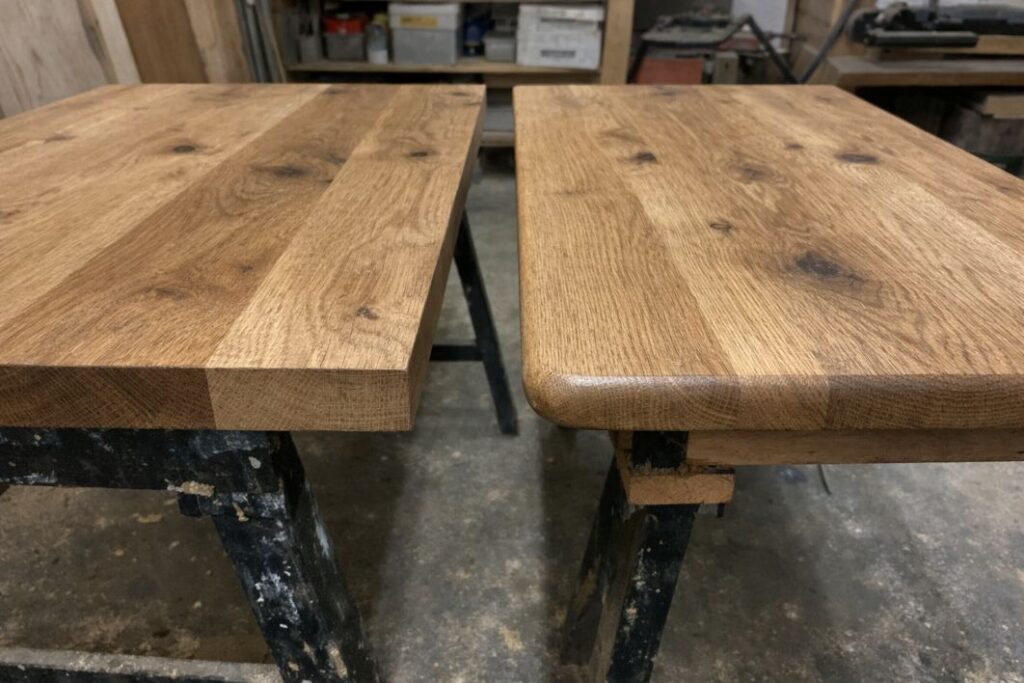
Simple edge profiles A squared or lightly bevelled edge can be replicated or cleaned up more easily than ornate or deeply rounded edges. Consistency along the perimeter is important for both aesthetics and tactility.

Grain direction aligned for movement control Grain should run consistently along the length or width. This allows reshaping without disturbing natural wood behaviour. Tablemaker, for example, aligns grain for structural stability and includes straightening bars to help resist warping and cupping.

Here is a short checklist of construction types likely to be suitable:

  1. Solid wood (oak, ash, walnut) in full-stave format
  2. No major inlays or integrated features
  3. Edges with simple profiles that can be re-created
  4. Tops at least 20mm thick for trimming and re-finishing
  5. Straightening bars that can be removed and refitted

If a table meets these standards, resizing is often workable with the right tools and experience.

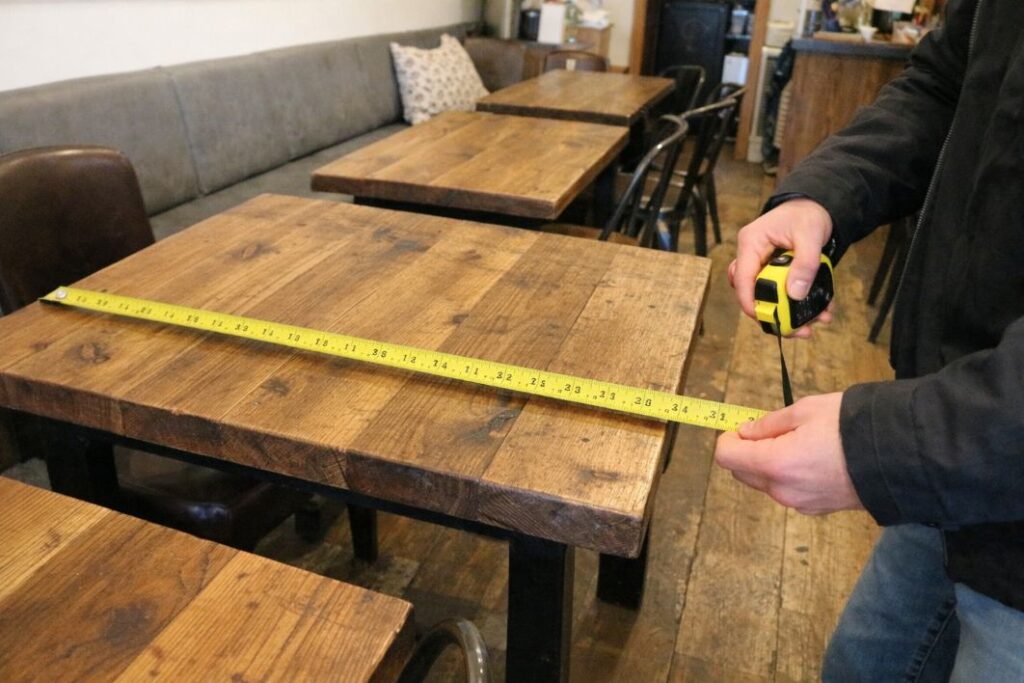
Pro Tip: Always measure your new space fully before considering resizing, including doorways and clearances, to confirm fit.
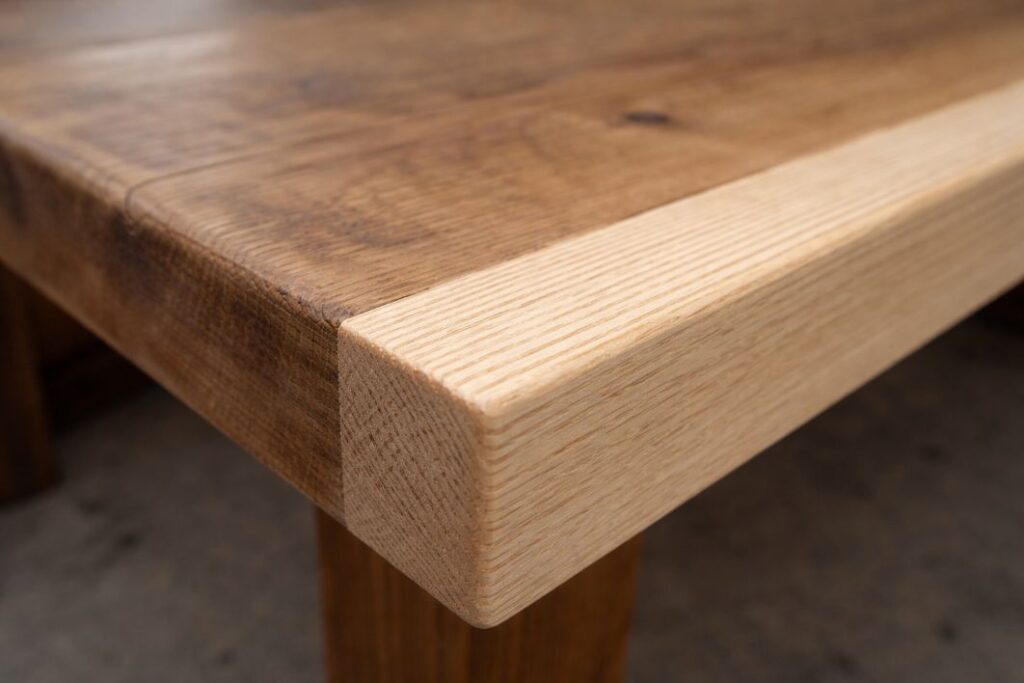
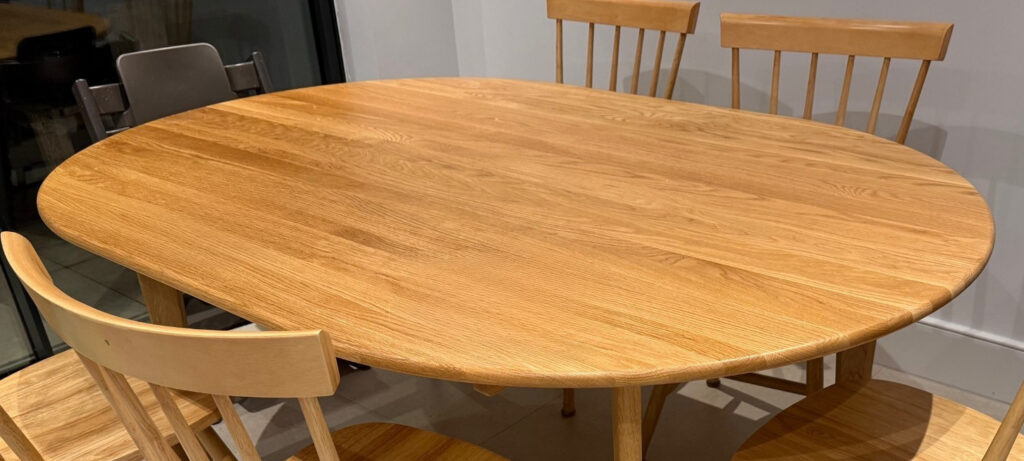
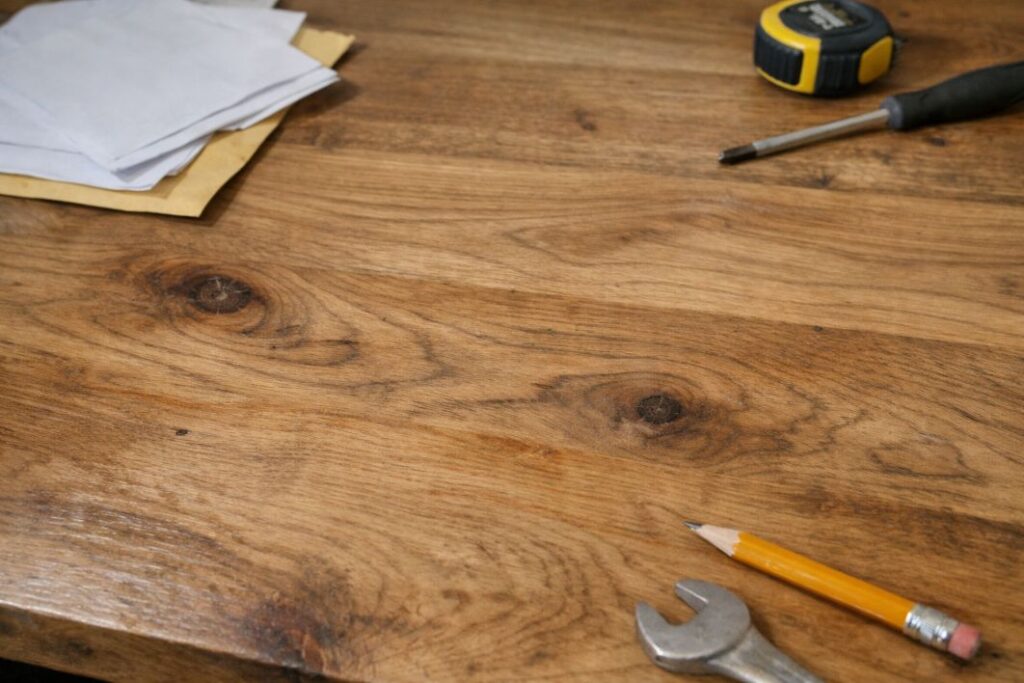
An AI photo displaying a solid oak table edge

Pro Tip:For consistent visual results, request sample finishes to test how new cuts will blend with your existing top.

What Can’t Be Resized: Limits Set by Design and Use

Some tops are simply not built for resizing. Attempting to do so can damage the piece or leave it unsuitable for use.

Non-resizable features and materials include:

  • Veneered MDF or chipboard: These often have a thin wood layer over a particle core. Cutting them risks splintering and exposing the raw middle, which does not accept finishing or moisture well.
  • Live edge designs: Trimming a live edge undermines the key visual appeal and balance of the piece.
  • Integrated features like cable ports or resin inlays: Resizing may misalign these features or render them unusable.
  • Prefixed mounting systems: Tops that rely on embedded or obscured fixings can be difficult or impossible to reconfigure without weakening the structure.
  • Edge detail too complex to replicate: Hand-carved or multiple-profile edges can become asymmetrical or mismatched after cutting.

In any of these cases, a table top may need to be preserved as-is or replaced entirely. Recognising these limits early prevents unnecessary risk and expense.

How Much Can You Resize? Practical Size Constraints

Even with a solid wood top, there are limits to how much material can be removed without creating issues with function or appearance.

Key constraints include:

  • Minimum depth and width: Dining tables benefit from a surface depth of at least 80cm for central serving space, while desks typically require at least 60cm for monitor and keyboard use.
  • Edge symmetry: Removing too much from one edge can make the piece look unbalanced. Aim to size down from all sides evenly if possible.
  • Legroom and overhang: Reductions can impact how chairs fit, especially if the base is fixed and legs no longer align well with the new proportions.
  • Thickness loss: Cutting and refinishing often removes up to 5mm from the outer edge. Tables under 20mm thick after resizing may feel or look insubstantial.
  • Straightening bar refitting: Some tops rely on internal bracing to stay flat. Resizing must factor in refitting these at appropriate points, or the surface may warp over time.

It is worth noting that visual balance matters just as much as function. A table that technically fits in a room may still feel undersized if the scale is off relative to other furniture or architectural features.

Get a Table Top Resizing Assessment

Unsure if your current table can be resized? Our team will evaluate the construction and condition before advising next steps.

Request Assessment

What Tools and Expertise Are Required?

Resizing a table top is a skilled task. While it might seem similar to cutting a shelf to length, the risks are far greater. Precision, stability, and surface quality are all important.

Professional workshops use:

  • Track saws or cabinet saws for straight, clean cuts
  • Edge planers to true up the perimeter after cutting
  • Orbital sanders and grain matching tools for blending the exposed areas
  • Colour-matched hardwax oils to blend any refinished areas with the original surface

Beyond the refinishing itself, understanding of wood movement and bracing is necessary to maintain the top’s long-term shape. This includes refitting straightening bars or resupporting the base if fixings shift due to the new size.

Attempting this work without the right experience risks:

  • Ravelling the veneer or pulling fibres unevenly
  • Creating unsquare edges that affect how the table sits or feels
  • Mismatched finishes that are visible in certain light
  • Warping due to improper sealing or bracing

At Tablemaker, resizing projects are treated as custom commissions. Each adjustment is assessed based on the table’s structure, use case, and expected handling over time.

What Happens to the Finish and Edges?

Changing the size of a table top means interrupting its surface and finish. These elements are restorable, but not always to their original state.

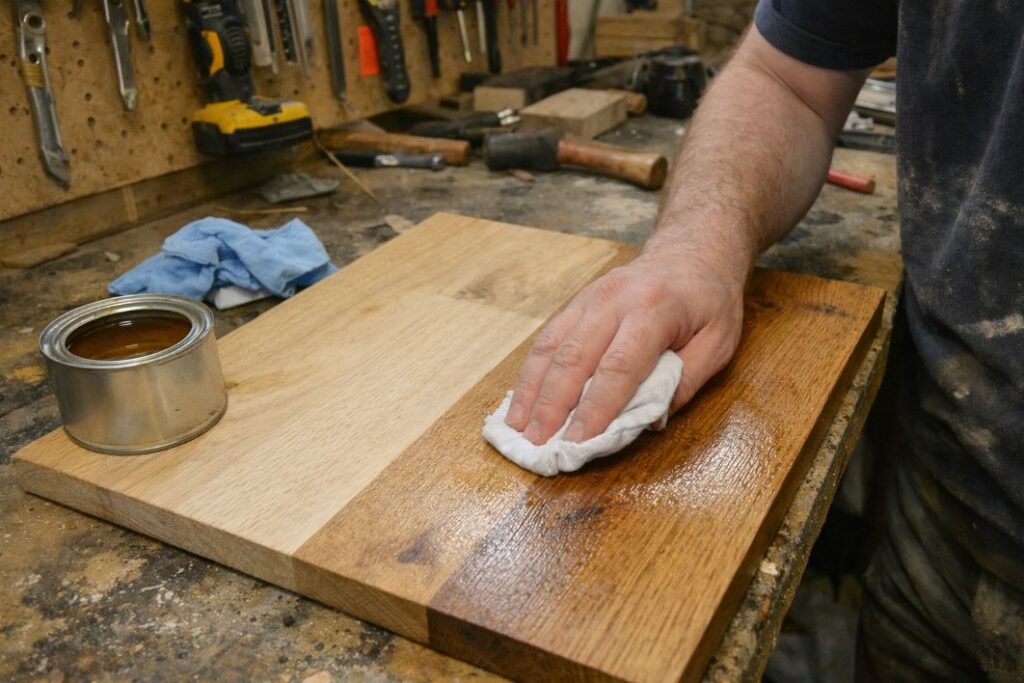
Finish Most solid wood tops are protected with hardwax oil, which penetrates the grain while leaving a natural texture. When edges are cut, the bare wood must be re-oiled to match the rest of the surface. While colour and sheen can be closely approximated, perfect blending is not always possible due to age, wear and light exposure on the original finish.

Edge profile Replicating a simple bevel or chamfer is usually straightforward. However, if the table had a non-standard or heavily sculpted edge, a perfect match may not be feasible, especially if machinery used in the original build is no longer accessible.

Colour and grain Cut edges reveal fresh grain, which can appear lighter until oxidised or oiled. Over time, exposed cuts will mellow, but initial colour contrast is a reality. For some clients, this marks a welcome sign of the table’s evolution. For others, it may be a distraction.

Typical outcomes that are restorable:

  • Edge finish and protection
  • General surface sheen uniformity
  • Structural integrity

Outcomes that are harder to match exactly:

  • Colour tone at newly exposed edges
  • Specific grain or texture pattern
  • Unique wear patterns and patina

When Is It Better to Replace Than Resize?

Resizing offers flexibility, but replacement is sometimes the more logical route. Knowing when to start fresh can save time, expense and ongoing frustration.

Reasons to consider replacement:

  • Cost similarity: Labour and refinishing involved in resizing can approach or exceed the price of a new top, especially for straightforward configurations.
  • Design opportunity: A new top can be sized, proportioned and adapted more precisely to its intended use or space.
  • Material upgrade: Swapping a softwood or veneer top for solid hardwood may improve longevity and usability.
  • Functional rethink: Changes in use, such as moving from casual dining to office work, often come with new ergonomic or storage needs best served by a redesign.
  • Preserving the original table elsewhere: In some cases, the current table may be better kept intact and relocated to another space, while a new table is created for the new fit.

Tablemaker often supports clients through this decision by discussing both resize potential and replacement advantages, depending on the construction and use case.

Ultimately, the best route is the one that respects both the table’s qualities and the user’s needs going forward. Whether resized or renewed, the goal is a piece that functions well and lasts for years to come.

Explore Custom Table Top Options

 If resizing is not viable, we can design and build a new top to your exact size, use, and finish preferences.

Start Custom Design

Tablemaker

55 High St, London N8 7QB

02083416334

HVQM+58 London

 

Posted on

Best Table Top Edge Profiles for Busy Venues (Comfort, Durability, Cleaning Reality)

Best Table Top Edge Profiles for Busy Venues (Comfort, Durability, Cleaning Reality)-Tablemaker

Best Table Top Edge Profiles for Busy Venues (Comfort, Durability, Cleaning Reality)

Which edge profiles are most suitable for high-traffic venues like cafés and restaurants?

The most suitable edge profiles for high-traffic venues prioritise comfort, long-term durability and ease of cleaning. While the visual finish matters, function tends to dominate these settings due to intensive daily use and frequent contact from both staff and guests.

Practical impact of edge profiles in busy venues

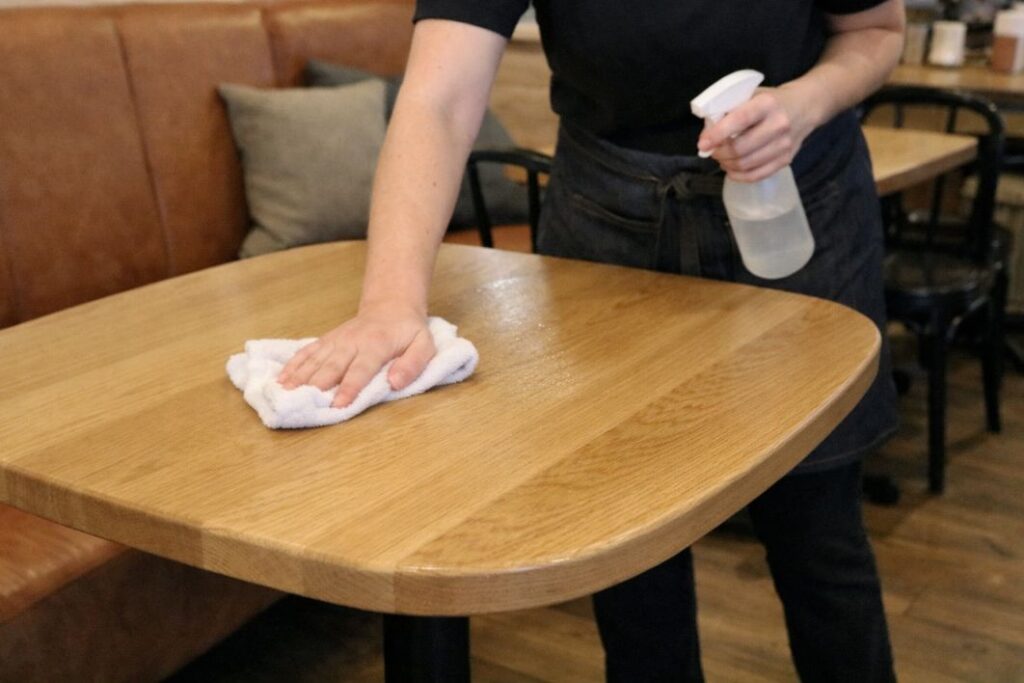
In a busy café or restaurant, each table might be wiped clean over 30 times in a single day, while edges face constant contact from trays, chairs and guests’ clothing. This frequency of use reveals limitations that might not be obvious in a showroom or domestic setting.

Edge profiles directly influence:

  • Wear resistance: Rounded or angled edges tend to mask wear better than crisp corners, which are prone to chipping.
  • Comfort: Arm placement, chair movement and cleaning all interact with the edge, especially in close quarters.
  • Cleaning efficiency: Crevices or sharp transitions can trap debris or resist cloth glides, slowing routine upkeep.
  • Visual perception: A softer edge can come across as more informal or accessible, which may suit venues aiming for a relaxed feel.

Edge details are often overlooked, yet their performance plays a central role in the usability and upkeep of commercial surfaces.

Table of Contents

An AI photo of a commercial-grade solid oak table

Square Edge: Clean Look, Hard Corners

The square edge offers a sharp, modern profile that pairs well with minimal or industrial interiors.

Pros:

  • Clear, defined lines that create a contemporary look
  • Flat sides make surface cleaning straightforward

Cons:

  • Corners are vulnerable to chipping, even with solid wood
  • Elbows, thighs and tray edges frequently come into hard contact
  • Less forgiving when chairs or stools knock into table sides

Square edges may suit fixed wall-mounted tables or counters with limited direct contact. Where aesthetics must take precedence and wear is lower, it remains a valid choice. Tablemaker can reinforce corners where needed to mitigate common impact points.

Radius Edge: Softened for Safety and Comfort

In a setting where children might run past tables or where staff move quickly between close-set seats, rounded edges offer peace of mind. A radius profile softens both the top and underside of the edge, removing harsh angles.

Functional benefits include:

  • Reduced risk of knocks or grazes for guests and staff
  • Easier cloth glide during cleaning, with no sharp corners
  • Improved resistance to visible wear on high-contact points
  • Widely compatible with family-oriented or informal venues

A smaller radius retains a relatively structured feel, while a larger radius leans toward a more casual and softened presence. Tablemaker can adjust the radius to suit both look and utility.

Some buyers may view this as less refined than a crisp square finish. However, when comfort, speed and safety guide the brief, the radius edge is often the most balanced option.

Pro Tip: In tight seating layouts, avoid undercut profiles like sharknose to reduce the risk of lower limb knocks.

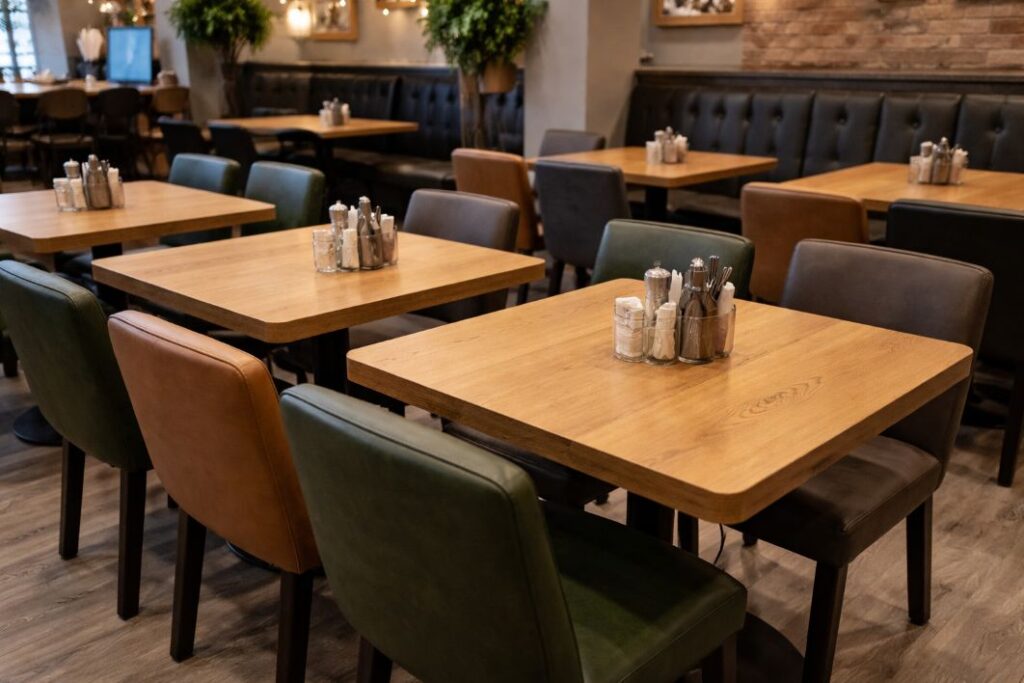
An AI photo displaying various solid oak cafe tables.

Pro Tip: For venues with rapid table turnover, a radius or hybrid edge can cut down daily cleaning time significantly.

Chamfer Edge: Subtle Angles, Mixed Results

A chamfer is an angled cut along the edge, typically about 30 to 45 degrees, which eases the transition between horizontal and vertical planes.

Benefits:

  • Visually reduces the thickness of a table top
  • Slightly softer to the touch than sharp edges
  • Feels refined while remaining relatively subtle

Limitations:

  • Can wear quickly at the angled plane if heavily impacted
  • Not all chamfers are equal, depth and angle vary widely
  • May hinder cleaning if cloths snag or skip over the bevel

Chamfers work well in formal dining settings or commercial interiors where table turnover is lower and presentation is important. Tablemaker adjusts chamfer depths to balance visual simplicity with daily use considerations.

Bullnose Edge: Fully Rounded, Fully Practical?

Imagine the edge of the table smoothed like a river-worn stone, rounded all the way from top to bottom. That image captures the bullnose profile.

Pros:

  • Exceptionally forgiving on bumps, knocks and grazes
  • Comfortable for seated users and high-contact environments
  • Good fit for education spaces, informal dining or family pubs

Cons:

  • Food and residue may collect beneath the underside curve
  • Traditional styling may not suit modern or linear interiors
  • Cleaning requires more attention to follow the curve fully

For comfort-first venues, particularly those catering to children or high seating turnover, bullnose edges have ongoing value. Tablemaker offers adaptations with reduced curvature to balance visual weight and practicality, especially where a fully rounded edge might appear overly soft.

Request a Bespoke Table Edge Design

Our team can tailor edge profiles to suit your venue’s layout, safety needs and cleaning routines.

Enquire Now

Sharknose Edge: Sleek but Serviceable?

The sharknose profile creates a dramatic, undercut bevel on the underside of the edge. Visually, it gives the illusion that the table top is floating, especially when viewed side-on.

Advantages:

  • Creates a refined, architectural appearance
  • Reduces visual thickness of heavier tops

Drawbacks:

  • Underside angle can bruise knees or shins in tight spaces
  • Cleaning cloths struggle to reach the full undercut
  • Delicate edge may be more exposed to chips or scuffs

This profile belongs in lower-contact environments or where visual impact outweighs operational practicality. It can work for statement pieces, reception counters or quiet lounges. Tablemaker can produce modified versions that soften the underside cut to improve access and reduce edge fragility.

Custom Hybrid Profiles: Matching Use to Context

Standard options do not always meet the needs of complex or compact spaces. Some venues benefit from edge profiles that blend characteristics to suit their specific workflow, layout or audience.

Hybrid solutions may include:

  • A radius top with a chamfered underside for comfort and clarity
  • Shallow bevels that reduce sharp transitions without compromising cleaning
  • Profiles tuned to match custom bases or minimise wall proximity gaps

Tablemaker specialises in adapting edge designs to real-world layouts, such as shared workspaces, joined tables or rooms with architectural constraints. The aim is not unnecessary challenge, but a precise function, edges that meet context with purpose.

In spaces where clients move through frequently, where bags might scrape past or where cleaning routines must be quick and thorough, these seemingly small adjustments make day-to-day operations smoother and safer.

Explore Commercial Table Top Options

Browse our table top finishes and edge styles made for busy cafés, pubs and restaurants.

View Range

Tablemaker

55 High St, London N8 7QB

02083416334

HVQM+58 London
 

Posted on

The Commercial Table Top Ordering Checklist: Measurements, Edge, Finish, Fixing

The Commercial Table Top Ordering Checklist Measurements, Edge, Finish, Fixing-Tablemaker

The Commercial Table Top Ordering Checklist: Measurements, Edge, Finish, Fixing

What must you consider before ordering a commercial table top?

To ensure your commercial table top fits, functions and lasts, you need to plan carefully across several dimensions. These include accurate measurements, edge selection, finish type, fixing method and allowances for solid wood behaviour. Each choice affects performance, appearance and ease of installation.

Table of Contents

An AI photo of a commercial-grade solid oak table

Confirming the Right Measurements for Your Space and Base

In high-traffic environments, measurements are non-negotiable. A few centimetres in either direction can mean the difference between efficient movement and persistent bottlenecks.

Before ordering, check the following:

  1. Table footprint: Measure both length and width based on available floor space, including nearby fixtures and access routes.
  2. Overhang and legroom: Ensure enough space for legs and chairs. Aim for 30cm of overhang on long sides when seating is planned.
  3. Clearances: Allow at least 90cm walkway behind seated diners in restaurants or cafés, and 120cm in areas used for circulation or accessibility.
  4. Base compatibility: Compare the footprint and fixing points of your base with the intended top dimensions.
  5. Seating vs. spacing: A six-seater setup may demand different dimensions in a co-working space than it does in a casual bistro.

Commercial layouts often require more precise planning than domestic ones. Fixed seating, shared working zones and fire regulations leave little room for guesswork. Where off-the-shelf increments do not sit comfortably within your available space, made-to-measure tops provide important flexibility.

Choosing the Right Edge Profile for Function and Feel

Edge selection is not just aesthetic; it shapes how a table feels in use and how it performs over time.

Common options include:

  • Square edge Pros: Clean modern look, precise lines. Cons: Sharper corner feel, more prone to knocks.
  • Chamfered edge Pros: Softens the visual weight, offers chip resistance. Cons: Slightly more complex to clean along the angle.
  • Rounded edge (radius or bullnose) Pros: Safer in public or child-friendly spaces, smooth to touch. Cons: More relaxed appearance may not suit all interiors.
  • Bevelled edge Pros: Adds refinement without bulk, reduces edge wear. Cons: Less tactile for high-traffic environments.

In a busy café, where tables are cleaned regularly and moved often, a chamfered or rounded edge reduces impact and wear. In a quieter workspace, a square or bevelled edge might suit minimal visual setups while maintaining usability. Consider how the table will be used, cleaned and approached daily.

Pro Tip: Use paper templates cut to size in your space to visualise overhang and movement areas before confirming table dimensions.

An AI photo displaying a solid oak table edge comparison

Pro Tip: If reusing an existing base, photograph the mounting points and bring dimensions to consultation to avoid misalignment issues later.

Selecting a Finish That Withstands Commercial Use

Finish influences appearance, yes, but more critically it governs how the wood responds over time.

Comparison of common finishes:

  • Hardwax oil Resists spills, allows spot repairs, food safe. Suited to cafés, restaurants and offices needing cleanable yet repairable surfaces.
  • Lacquer Glossy or matte, forms a protective film. Tough initial barrier but harder to renew locally once damaged.
  • Polyurethane Highly water-resistant, plastic-like finish. Durable but often non-breathable, which can trap moisture and reduce repair options.

Many commercial clients expect water resistance but find later that a scratch or stained patch may require full refinishing. Hardwax oil achieves a practical balance, offering solid protection alongside the option to renew specific areas without heavy equipment or downtime. Tablemaker applies this finish as standard for that reason. It performs well while respecting the material beneath.

Understand Fixing Options and Base Compatibility

How your table top is secured to its base matters more than many expect. Poor fixing can result in cupping, instability or limits on future reuse.

Common methods include:

  • Brackets: Often used with metal frames, these secure directly into the underside but may limit movement if positioned incorrectly.
  • Threaded inserts: Allow for repeat fixings and reassembly, useful for relocatable furniture or modular layouts.
  • Straightening bars: Supplied with many Tablemaker tops, these counteract wood movement. They may also influence where fixings can be placed.

Undrilled tops are often preferred in commercial contexts because they can be matched to existing or non-standard bases on site. Drilling in advance without precise base data risks misalignment or weakening the structure. Compatibility checks should happen early, especially if using a third-party frame or reusing existing bases.

Before ordering, check:

  1. Base size and mounting point positions
  2. Intended fixing method
  3. Movement allowance needs
  4. Whether the base accommodates straightening bars
  5. Delivery of top and base in the correct sequence for safe fitting

Factoring in Wood Movement and Stability Over Time

Solid wood tables respond to humidity and temperature. This is not a fault but a characteristic of the material.

How movement is managed:

  1. Grain direction is chosen to support long-term stability.
  2. Kiln-dried timber lowers the risk of excessive expansion.
  3. Straightening bars help resist cupping, especially on wider tops.
  4. Finish choice impacts moisture protection without sealing the wood too tightly.
  5. Fixing allowances are important to enable natural expansion and contraction.

Warpage concerns often arise when tops are rigidly fixed with no room to shift. This is especially problematic in heating-rich or air-conditioned interiors. Simply understanding that solid wood will move, and planning for it, avoids most issues before they occur.

Explore Made to Measure Table Tops

Choose a size, finish and edge profile that fits your exact space and specification. Designed and built for high-traffic commercial use.

Browse Made to Measure

Matching Table Tops to Commercial Use Cases

Every setting places different demands on a table top. What suits a fast-turnover coffee shop may not suit a shared hot-desk setup.

Use cases compared:

  • Café / Restaurant: Needs a durable, easy-clean top with edge protection. A 32mm thickness gives a sturdy impression. Hardwax oil suits frequent wipe-downs.
  • Co-working / Offices: Prioritises leg space, cable clearance and minimal edges that allow for close seating. Rounded or bevelled edges improve comfort. Tops must work with sit-stand frames or mobile legs.
  • Formal dining venues: Often choose wider tops with generous overhangs. A bevelled or square edge maintains visual definition without being aggressive.
  • Multi-use spaces: Flexibility and easy repositioning matter most. Lighter finishes and standard base compatibilities become desirable.

Thickness plays both structural and visual roles. A 26mm or 32mm board offers strength and heft. For longer spans or thicker looks, tops at 36mm or above may suit, especially where presence matters.

Clarifying Lead Times, Delivery and Installation Readiness

Made-to-order furniture demands a little planning. Nearly all Tablemaker commercial orders are produced and delivered within two to three weeks, but the whole process benefits from early clarity.

To prepare for installation:

  1. Confirm base specifications and ensure they arrive on time.
  2. Measure access routes including lifts, doorways and stairwells.
  3. Arrange suitable storage if installation will not happen immediately.
  4. Decide who is responsible for drilling and fixing on site.
  5. Inform delivery contacts about commercial access issues or timing restrictions.

Undrilled tops mean greater adaptability but do require forethought. Installation is smoother when fixing methods are decided in advance, particularly when using bespoke or imported bases. If a table is needed for an event or opening, build in margin for fixing and levelling.

Few businesses enjoy surprises during a fit out. Accurate information, shared early, prevents delay and damage, making the entire process smoother from workshop to workspace.

Talk to a Specification Adviser

Unsure about measurements, fixing or finish? Our team can guide your order to ensure perfect fit and lasting performance.

Request a Consultation

Tablemaker

55 High St, London N8 7QB

02083416334

HVQM+58 London
 

Posted on

Hot-Desking Surfaces: What Specs Matter When Desks Get Abused Daily

Hot-Desking Surfaces What Specs Matter When Desks Get Abused Daily-Tablemaker

Hot-Desking Surfaces: What Specs Matter When Desks Get Abused Daily

What physical demands do hot-desking surfaces face that affect their durability?

Hot-desking surfaces endure constant turnover, unpredictable use, and minimal personal responsibility, which exposes them to more wear and stress compared to private desks. This includes frequent cleaning, varied mounting frames, and near-daily interactions that cumulatively affect desk longevity.

Table of Contents

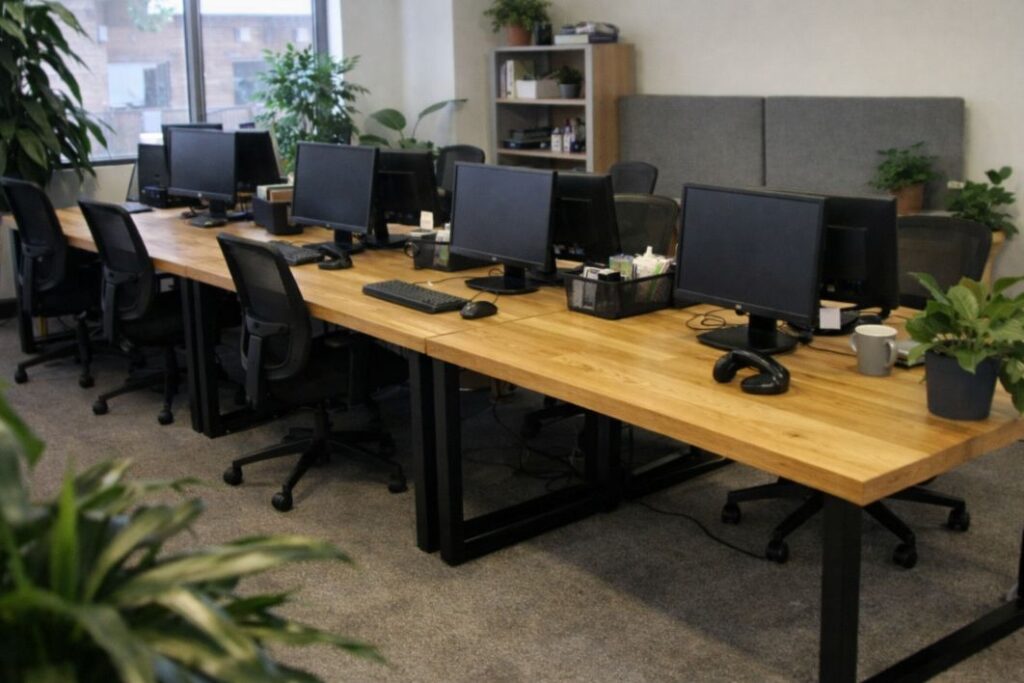
An AI photo of a commercial-grade solid oak desk top

What Hot-Desking Surfaces Actually Endure

Shared desks are often judged by how they look in a showroom, but the reality in use is far less forgiving. Facilities managers often find that surfaces fail not from one major event, but from persistent, low-level stress.

Here are some of the most common wear patterns in hot-desking setups:

  • High-frequency contact: Users slide laptops, bags, and coffee cups across the surface repeatedly throughout the day. Unlike a personal desk, there is no consistent handling that slows wear.
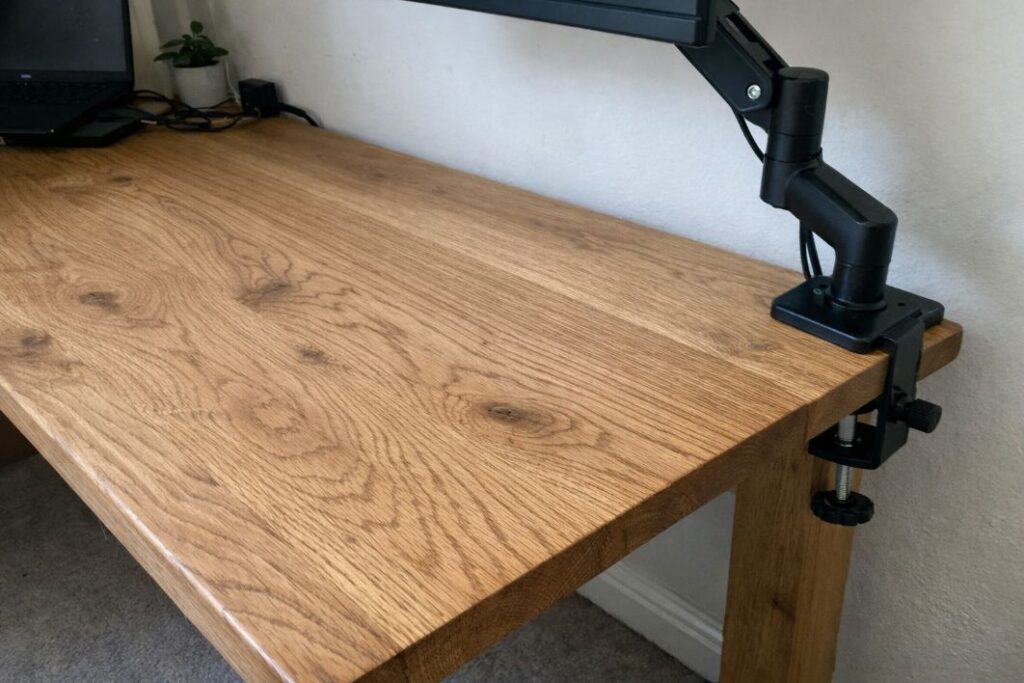
  • Mixed mounting environments: Sit-stand frames, clamp-on accessories or monitor arms apply varied stress to the surface, especially when multiple users adjust them in different ways.
  • Daily cleaning routines: Sanitising wipes, alcohol sprays and general wet cleaning slowly degrade finishes not built to cope with them. Glossy or plastic-like coatings often show streaking or degrade unevenly.
  • Impersonal use: Users typically show less care than they might with personal furniture. That translates into more dropped items, increased edge bangs and improperly mounted peripherals.

Office layouts with floating or repositionable desks introduce additional pressures, including frequent reconnections to different frames or loosely fitted mounts. Over time, screw holes may widen, edges may fray and finish layers may peel, particularly on thinner or synthetic surfaces.

Why Solid Wood Outlasts Veneers

First impressions can be misleading. Veneered chipboard or MDF might appear similar to solid wood when new but respond differently after six months of constant use.

Solid wood tops offer advantages that go beyond appearance:

  • Repairability: Scratches, dents and edge dings can be sanded back and refinished. Veneer, which is often less than 1mm thick, won’t tolerate this.
  • Moisture resilience: Wood reacts to spills by absorbing into the grain, which can be addressed through refinishing. Veneers typically bubble or delaminate.
  • Longevity under impact: Solid boards, especially full-stave sections, handle repeated knocks better and show graceful wear rather than sudden material failure.
  • Grain behaviour: With correct construction techniques such as grain orientation and drying standards, solid wood resists warping more effectively in varying conditions.

The perception that all wood is soft or vulnerable overlooks how different grades and cuts perform. Oak, for example, combines strength with the capacity to be resurfaced repeatedly. This makes solid wood desk tops suitable for shared spaces, where surface integrity matters every day rather than only at point of delivery.

Pro Tip: Avoid mounting hot-desking tops with fixed drill holes unless you are certain the frame style will remain unchanged long term.

An AI photo displaying various solid oak desks.

Pro Tip: A desk top with rounded corners or edge radius can significantly reduce visible wear and damage from repeated multi-user contact.

Surface Finish: Protection Without Plasticity

The ideal finish in a hot-desking environment needs to protect without forming a hard, non-repairable shell. Tablemaker uses hardwax oil on its desk surfaces for this reason.

Compared to polyurethane or lacquer, a hardwax oil:

  • Penetrates into the wood instead of sitting on top
  • Is less prone to cracking or peeling under cleaning routines
  • Can be refreshed in sections without fully stripping the surface

This means that after the inevitable coffee spill or scuff from a metal laptop stand, the damage can often be corrected without removing the desk from use. Recoating is typically a light-touch process that preserves function and appearance.

A finish with a lower sheen also distributes surface reflection more evenly, making finger marks or scratch paths less visible. In offices where cleaning is regular but not always gentle, avoiding a plasticky buildup helps maintain a consistent look over time.

Thickness and Stability: Why Millimetres Matter

Desk tops under hot-desking conditions are rarely treated gently. They support equipment, absorb friction, and span variable gaps between frame points. Structure becomes just as important as surface.

Thickness For commercial or high-turnover use, anything under 22mm may eventually flex, especially on wider tops. Tablemaker offers tops beginning at 22mm but often supplies 25mm or thicker for sit-stand compatibility and heavier use.

Straightening bars Longer or more detailed tops benefit from additional support beneath the grain. Tablemaker fits wooden or metal straightening bars to stabilise the top without compromising its ability to move naturally with seasonal changes.

Grain direction Orientation is chosen for both look and performance. Boards are joined to minimise differential movement, reducing the chance of cupping or bowing that can occur in unstable humidity conditions.

Mounting stress When tops are attached to adjustable frames, uneven distribution of weight and torque can result in gradual distortion. Reinforcement combined with appropriate thickness helps resist this over time.

Structural integrity is invisible but important. Thickness and grain alignment directly influence lifespan in unsupervised, multi-user conditions.

Mounting Compatibility: Undrilled Isn’t an Oversight

In shared work environments, desks may need to be re-mounted multiple times over a year. Yet factory-drilled holes can become a source of future problems when frames change.

Tablemaker supplies desk tops undrilled as a deliberate measure to support reuse and precision. This avoids:

  • Faulty alignment: Pre-drilled holes rarely match varied frame designs, especially for sit-stand bases or custom setups.
  • Weakening over time: Screws reused in the same poor-fit holes can strip or fail to hold.
  • Constraint during maintenance: A top can’t be rotated or moved to even out wear patterns if locked into a fixed drill pattern.

Compatibility also includes features like cable trays, clamps, and data units. Offices change configurations more frequently than they used to. An undrilled top extends the lifespan and allows facility teams to decide when and how to mount.

For hot-desking setups, flexibility extends beyond the staff. The fixtures need to adapt without causing damage.

Discuss a Custom Desk Project

Speak to our team about your hot-desking needs and see how we can create surfaces suited to your exact space and usage.

Start Your Project

Size and Shape: Fitting the Space, Not Just the Frame

Mass-produced desk sizes rarely account for radiators, wall gaps, uneven alcoves or cable management. Shared spaces demand more than standard dimensions.

Custom sizing helps avoid issues such as:

  • Clearance issues behind monitors due to wall proximity
  • Clashing with window handles or sockets in tight layouts
  • Inaccessibility caused by oversized depth or poor leg clearance

Tablemaker offers sizing in 1cm increments, which supports creative layouts and shared benches that feel intentional rather than improvised. Tabletops can also be shaped to account for pipe cutouts, curved walls or corner skews.

Common adjustments include:

  • Reducing depth while maintaining width for laptop-only zones
  • Angle-cut corners to allow passage in narrow corridors
  • Slotting for cable trays or capability access grommets

The better a surface fits its environment, the less likely it is to suffer accidental damage, tipping or disuse. In hot-desking setups, fit contributes directly to function.

When Desks Can Be Refinished, Not Replaced

Hot-desking surfaces wear fast because no one user owns the wear. The best answer is not perfection, but reversibility.

Refinishing allows worn or scratched surfaces to be sanded back and restored. Compared with the cost of full replacement, this represents a significant saving over time, especially when factored across multiple desks in commercial settings.

For example:

  • A full desk replacement may cost several hundred pounds and take weeks to coordinate.
  • A professional re-oil or sand-back can often be completed in a few hours at a fraction of the cost.

Solid wood, particularly oak, supports this cycle. Tablemaker’s workshop sees many surfaces return after five to ten years for a full resurface, not because they failed, but because re-use was prioritised over waste.

In procurement and sustainability planning, the ability to restore is no longer a bonus. It is a responsible baseline for any surface expected to endure daily, indifferent use. A well-made, well-fitted, repairable surface is not just an object. It is an asset.

Request a Sample Finish

Unsure how our finishes hold up? Request a sample to see the texture and durability in your own hands before you commit.

Request a Sample

Tablemaker

55 High St, London N8 7QB

02083416334

HVQM+58 London

 

Posted on

How to Compare Quotes for Solid Wood Table Tops When Every Supplier Specs Differ

How to Compare Quotes for Solid Wood Table Tops When Every Supplier Specs Differ-Tablemaker

How to Compare Quotes for Solid Wood Table Tops When Every Supplier Specs Differ

How can you fairly compare quotes for solid wood table tops when specifications vary?

To compare quotes meaningfully, you must first understand what each supplier is actually including. Differences in wood type, construction, finish, and compatibility can all affect pricing. A quote for a solid wood top is only as useful as the details it contains, and misleading or missing specifics are common.

Table of Contents

An AI photo of a commercial-grade solid oak table in a workshop

Clarify What Each Quote Really Includes

The term “solid wood” is often used broadly, but not always accurately. Some quotes refer to full-stave solid timber, while others might include finger-jointed panels, edge-glued lamellas or even veneers over MDF. These differences are substantial but not always obvious on a quote.

It is also common for certain items to be left out of initial pricing. These may include:

  • The type of finish (and whether it is included)
  • Mounting details such as pre-drilled holes or bracket compatibility
  • Delivery and packaging charges
  • Straightening bars or other reinforcement features

Additionally, quoting formats vary. Workshops may itemise construction, sanding, and finishing stages, while retailers might offer flat pricing without detail, making comparisons feel opaque.

Understanding the following key elements when reviewing a quote will help:

  • Wood type and grade: Higher-grade hardwoods cost more but offer better consistency and behaviour over time
  • Construction method: Full-stave boards are typically stronger and more stable than finger-jointed or laminated alternatives
  • Finish specification: Some suppliers offer lacquer, while others use repairable oils
  • Mounting preparation: Undrilled tops provide flexibility but may be quoted differently
  • Delivery terms: Look for lead times, packaging care, and courier type

Without this information, a cheaper quote may appear attractive but miss key functionality or longevity.

Consider Wood Type and Longevity

Material choices play a central role in both cost and performance. Oak tends to be a popular default for good reason, but suppliers may quote for different hardwoods that look similar yet behave quite differently.

Here’s a practical comparison:

  • Oak: Dense, stable, and widely available. Can be sanded down and refinished multiple times. Suited to surfaces experiencing frequent use.
  • Ash: Similar looks to oak but with slightly more movement. Still hardwearing, but not always as dimensionally stable.
  • Walnut: Visually striking and softer under pressure. Carries a premium price but is more prone to dents and surface wear.

Also worth checking are timber sourcing and environmental claims. FSC certification or assurance of kiln-drying matters for both sustainability and structural behaviour. Moisture levels in the timber should be matched to indoor environments to reduce seasonal movement.

Understand How Thickness and Construction Affect Stability

A thicker top may look more substantial but is not always the better option if stability is overlooked. Solid wood moves over time in response to temperature and humidity changes, and thicker tops are heavier and more prone to cupping without proper support.

Key factors to look for in the quote:

  • Straightening bars: These help stabilise large surfaces and reduce warping risk. Some are wood, others metal, and they may be removable for alternate mounting setups.
  • Grain orientation: Boards with mismatched grain can twist or split over time. Good workshops align grain direction for functional rather than aesthetic reasons.
  • Joinery method: Full-stave construction uses continuous planks across the depth of the table. Finger-jointed or laminated boards piece together shorter cuts, often at lower cost but sometimes with greater movement.

Tablemaker, for example, uses full-stave oak with integrated straightening solutions to reduce these risks without permanently locking in mounting methods.

Pro Tip: Always request moisture level data for the timber to ensure it suits indoor use and avoids seasonal warping.

Pro Tip: Clarify if straightening bars are removable or fixed, especially for adjustable frame setups.

Factor in Finish Type and Maintenance

The surface finish affects both first impressions and long-term upkeep. A quote that omits this detail leaves a large gap in understanding.

Two common finishes:

  • Hardwax oil: Allows the wood to breathe while providing a natural, repairable surface. Good for domestic settings where occasional sanding and re-oiling is manageable.
  • Lacquer or polyurethane: Offers a harder barrier-like finish which prevents stains but may crack or chip under contact. Harder to repair locally.

For real-life use, consider how the table will be cleaned, what type of wear it will face, and whether refinishing is something you are comfortable with. Coffee stains, pen marks and surface scratches are all more manageable when the finish allows local repair.

Quotes should be clear on whether the finish is included, which product is used, and whether maintenance guidance is provided.

Check for Mounting Compatibility and Undrilled Options

Not all quotes mention how the top is intended to be mounted, which is a leading cause of post-purchase frustration. A table top that arrives drilled or braced in an incompatible way can require return or costly modification.

Questions worth asking:

  1. Will the top come undrilled, allowing me to choose how it is fixed?
  2. If drilled, are the patterns compatible with standard fixed or adjustable frames?
  3. Are reinforcing bars included? If so, can they be repositioned?
  4. Is there enough underside clearance to allow for frame brackets or electronics?

Tablemaker supplies desk tops undrilled unless otherwise requested. This offers flexibility for fitting to a wide range of configurable frames including sit-stand systems. Quotes that account for mounting constraints up front will save time and potential disappointment later.

Consider Lead Time and What It Implies

A shorter lead time might sound appealing, but it’s worth understanding how that timeline reflects the supplier’s process.

Made-to-order production in small workshops typically allows better material control and less batch processing, even if lead times are longer than off-the-shelf items. For example:

  • 2 to 3 weeks: Often manageable for made-to-measure tops, assuming the workshop controls its schedule and materials.
  • Same-week dispatch: May indicate warehouse stock or prefabricated options. Check whether the item is finished or whether wood movement has been allowed for.

Speed is not inherently a red flag, but it is important to understand whether the piece is genuinely being made to your specification or allocated from existing inventory. Some finishes, such as hardwax oil, require time to cure before shipment. Timelines can also affect delivery expectations and coordination with other trade work.

Request a Custom Table Top Quote

Share your dimensions and finish preferences to receive a tailored quote based on real material and construction choices.

Get a Custom Quote

Think About Repairability and Future Use

A table top worth investing in should not be treated as disposable. Yet many quotes say little about how the surface can be maintained, refreshed or adapted years from now.

Solid hardwood surfaces, particularly oak, and can usually be sanded, re-oiled, or resized if constructed with that future in mind. In contrast, veneered or pre-lacquered alternatives may resist wear for a time, but do not allow for meaningful repair.

Useful things to check in the quote:

  • Can the surface be refinished if marked or scratched?
  • Are the finish products available for purchase or touch-up?
  • Are mounting and stability components removable or adaptable?
  • Will the supplier offer future refinishing, resizing or restoration?

Tablemaker’s approach treats a table as a functional, changing part of a space, not a fixed styling element. Quotes that reflect long-term usability add clarity to the purchase decision and can reduce total replacement costs over time.

Final Thought

Comparing quotes for solid wood table tops is not about chasing the lowest figure. It is about getting a clear picture of what is being offered, how it will behave over time, and whether it fits your particular space and function. By asking the right questions and understanding what affects price and performance, buyers can make confident, informed decisions that serve them well for years.

Speak with a Tablemaker Specialist

Discuss your space and requirements with one of our experts to ensure accurate quoting and practical fit.

Book a Consultation

Tablemaker

55 High St, London N8 7QB

02083416334

HVQM+58 London

 

Posted on

Office Desk Tops for Fit-Outs: How to Standardise Sizes Across Teams and Floors

Office Desk Tops for Fit-Outs How to Standardise Sizes Across Teams and Floors-Tablemaker

Office Desk Tops for Fit-Outs: How to Standardise Sizes Across Teams and Floors

Why is standardising desk tops important in office fit-outs across multiple teams?

Standardising office desk tops creates consistency that simplifies planning, reduces long-term maintenance, and supports flexible workspace changes. In team-based fit-outs, it also streamlines procurement and avoids friction during reconfigurations.

Inconsistent sizing across floors can lead to cluttered floorplans, incompatible layouts, and increased difficulty when rearranging teams. Standard desk sizing helps align furniture with operational needs, supports clear space planning, and creates a more coherent visual identity across departments.

Some practical benefits of desk top standardisation include:

  • Faster procurement processes and simplified supplier coordination
  • Easier floorplan updates during team moves or expansions
  • Improved compatibility with shared furniture components
  • Reduced visual clutter in open-plan environments
  • Lower cost of reordering, repair or replacement due to common dimensions

When managing large workplace fit-outs, standardisation becomes a tool for longevity, not restriction. It allows desks to support hybrid working models, clustering, and modular reconfiguration without needing a full redesign each time a layout changes.

Table of Contents

An AI photo of a commercial-grade solid oak table

Choosing a Core Size: What Dimensions Work Across Teams?

Finding a core size means balancing team requirements with spatial limitations. A single solution is rarely ideal for every situation, but most offices benefit from defined starting points.

Typical standard widths include:

  • 120cm: Suitable for hot desking, compact setups, or areas with circulation limits.
  • 140cm: A common compromise between usability and floor space.
  • 160cm: Frequently used by design or tech teams with dual-monitor setups or peripheral-heavy tasks.
  • 180cm: Appropriate for leadership roles or workstations with extensive layout needs.

Standard depths typically range from:

  • 60cm: Suitable for narrow areas or when screens are wall-mounted.
  • 70cm: Allows for comfortable use of laptops and monitors with some document space.
  • 80cm: Preferred where additional depth is needed for personal equipment or desk sharing.

Depth affects posture, storage and screen positioning. Too shallow, and users struggle with monitor distance. Too deep, and circulation or reach becomes difficult. Common office guidelines recommend a depth of 70 to 80cm for full-time desk use.

When planning across teams, the goal is not to eliminate variety entirely, but to define enough consistency that space planning remains predictable. The base size should support 80 to 90 percent of users, allowing exceptions where justified.

Managing Variations Without Losing Uniformity

Consistency does not mean every desktop must be identical. Flexibility is often needed, particularly when dealing with legacy bases, spatial constraints or leadership workspaces.

Effective strategies that retain coherence include:

  • Fixing depth across the office, while allowing width to vary by team or room
  • Keeping materials and finishes identical, even when slight size adjustments are made
  • Using fixed mounting locations to allow interchanging of tops within a shared system
  • Allowing well-defined exceptions, such as executive desks or corner units, while keeping bulk orders standard

Visual coherence comes from alignment, finish and material rather than perfect replication. A “family” of desk tops, with shared materials and detailing but slightly differing dimensions, allows usability without compromising the overall fit-out design.

Modular furniture systems often use consistent fixing and leg positions to make this easier. Planning for such variation in advance reduces on-site improvisation and costly replacements later.

Pro Tip: Fixing a consistent desk depth across all departments, even when widths vary, creates visual alignment and helps with space planning.

An AI photo displaying a solid oak table top

Pro Tip: By sourcing undrilled desk tops, you can reduce installation errors and maintain flexibility across different base designs.

Accounting for Base Compatibility and Fixing Methods

Desk tops must interface seamlessly with the frames beneath them. Fixing approach, compatibility and stability are just as important as dimensions.

To ensure flexibility during installation, many fit-outs opt for undrilled desk tops. This allows each top to be matched precisely to its base, whether fixed height, sit-stand or custom fabricated.

Key considerations for base compatibility include:

  1. Mounting holes: Different base models require distinct fixing patterns. Pre-drilling limits flexibility.
  2. Frame width: Desk tops should accommodate a range of frame spans without structural compromise.
  3. Sit-stand adjustability: Tops should support active movement while remaining stable and rigid.
  4. Cable management: Plan ahead for tray routing, grommets and capability access.
  5. Straightening bars: These are used to resist wood movement and should be positioned to avoid interfering with brackets and mounts.

At Tablemaker, mounting flexibility is maintained by supplying undrilled tops by default. This simplifies fit-outs involving varied or third-party bases and reduces error during installation. Straightening bars are removable and positioned with both stability and installation in mind.

Material and Finish Consistency Across Floors

Finish can have as much impact on perception as layout. In open plan or multi-storey offices, inconsistent materials or tones lead to visual disconnection and uneven wear.

Choosing solid wood helps ensure long-term consistency. Unlike veneered panels, which cannot be refinished, solid tops can be sanded and re-oiled to maintain uniform appearance across teams and over time.

To maintain finish consistency:

  • Select a single species and board width pattern for all tops
  • Specify grain direction for each layout grouping
  • Use hardwax oil to allow spot-repair and low-gloss finish continuity
  • Avoid mixing batches of tops from different manufacturers or suppliers
  • Plan for touch-up kits or professional refinishing during cleaning cycles

Maintaining consistent sheen levels and grain orientation helps create a unified feel between different zones. Over time, the ability to refresh finishes in place means fewer tops need replacing due to appearance alone.

Plan Your Office Fit-Out with Confidence

Speak with our team to streamline your next fit-out using scalable, standardised desk solutions tailored for modern workplaces.

Book a Planning Call

Planning for Growth and Reconfiguration

Offices evolve. Teams grow, layouts shift, and hybrid models increase desk sharing frequency. Choosing a standardised, compatible desktop dimension upfront means future expansion does not require starting again.

Some longer-term advantages of standard desk sizing:

  • Easier to add new desks using existing specs
  • Common tops can be moved between floors or rooms as needs change
  • Cluster configurations can be updated without disrupting visual layout
  • Shared workstations and hotdesks can be introduced without standalone furniture

For example, if a team of 12 expands to 18 in the same area, standard-sized tops allow new desks to slot into the layout rather than requiring a full redesign. The same applies to team combinations, room conversions or temporary relocations.

In these scenarios, investing in uniform, modular sizing avoids waste and speeds up transitions, particularly in leased or flexible workspaces.

Coordinating Procurement and Lead Times

Even with made-to-order furniture, predictable lead times and batch planning are achievable. In fact, standardised sizing often accelerates production, since fabrication setups can be repeated efficiently.

To coordinate effectively:

  1. Choose core sizes early in the fit-out planning to avoid last-minute changes
  2. Group orders by floor or phase to simplify delivery and on-site handling
  3. Share frame compatibility details with the supplier to avoid rework
  4. Clarify finish specification at batch level to avoid tone mismatches
  5. Allow buffer time for any bespoke exceptions or layout-driven variations

At Tablemaker, the workshop model is built around consistent throughout. Most standard desk top orders are produced within two to three weeks, even at volume. Early alignment between procurement and the workshop supports smoother delivery and faster fit-outs.

Where variations are needed, clearly separating standard lines from bespoke ones avoids confusion during production. Choosing one primary size, supported by limited variations, keeps procurement simple and timelines predictable.

Explore Made-to-Order Desk Tops

Browse our desk top range and discover flexible options that support layout changes, growth and hybrid working.

View Product Range

Tablemaker

55 High St, London N8 7QB

02083416334

HVQM+58 London