
7 Points Facility Managers Look for When Replacing Tables at Scale
What do facility managers prioritise when replacing tables at scale?
Facility managers look for tables that can withstand heavy use, remain consistent across batches, require minimal upkeep, offer repair options, meet safety standards, support standardisation, and deliver long-term value. These considerations underpin reliable commercial table procurement strategies and guide smart facility furniture replacement decisions.
Table of Contents
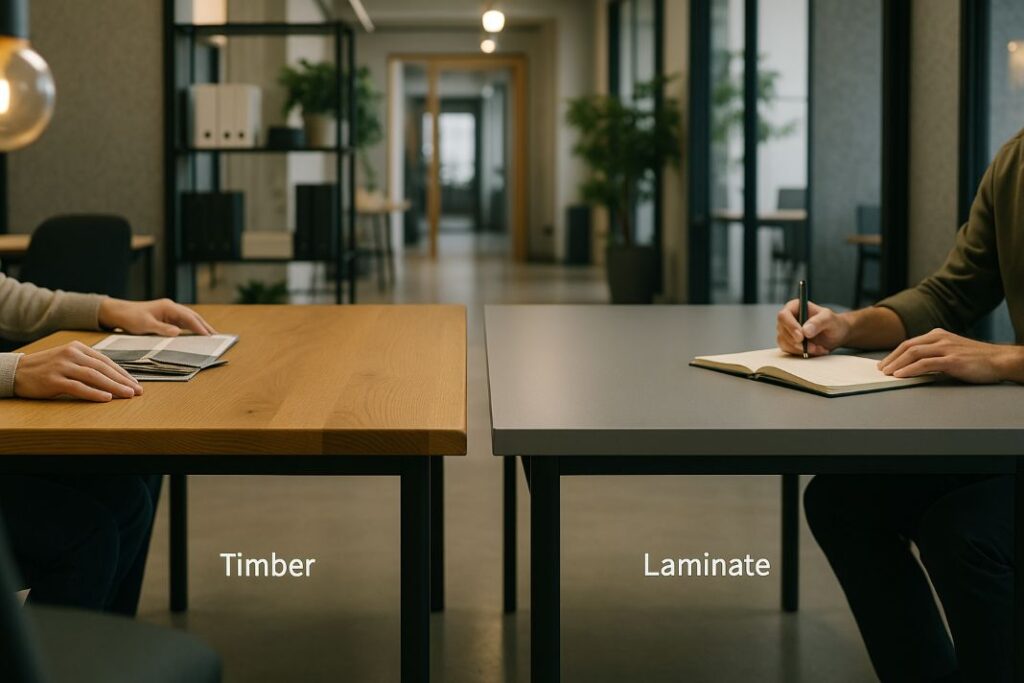
An AI photo comparing Timber vs Laminate desks.
Introduction: Why Replacing Tables at Scale Is a Different Decision
In facilities management, tables are not just pieces of furniture. They are operational assets with implications for safety, functionality, and lifecycle cost. A small flaw that might go unnoticed in a single unit can escalate into a significant operational risk when multiplied across a large estate.
Hospitals, universities, and public sector environments often require tables deployed at scale. Weak points such as joint fatigue or finish deterioration can disrupt operations, escalate costs, and undermine procurement credibility. Replacing tables at scale means adopting a structured, lifecycle-focused approach that prioritises standardisation, operational risk reduction, and asset planning.
Proven Durability Under Daily, High-Volume Use
What makes a commercial table truly durable?
In high-use environments, durability goes beyond the superficial. Tables must hold up under repetitive strain from cleaning, movement, and constant interaction. Over time, even minor weaknesses can lead to:
Surface delamination
Joint loosening
Edge wear
Hardware fatigue
Tables tested to BIFMA standards or built to contract-grade specifications are designed to withstand these stresses. For example, BIFMA X5.5 includes cyclic loading tests and static load tests to verify structural integrity under repetitive commercial use. Edge strength, joint reinforcement, and surface resilience all contribute to a table’s ability to endure.
Facility managers need products that demonstrate durable performance under routine use rather than only under ideal conditions. Custom commercial manufacturers such as Tablemaker – Made-to-Measure Tables for Commercial Interiors – often support this by building to specification, using high-performance materials like solid oak, American black walnut, and high-pressure laminates that suit demanding environments.
Pro Tip: Repairability is your insurance policy against costly replacements and downtime.
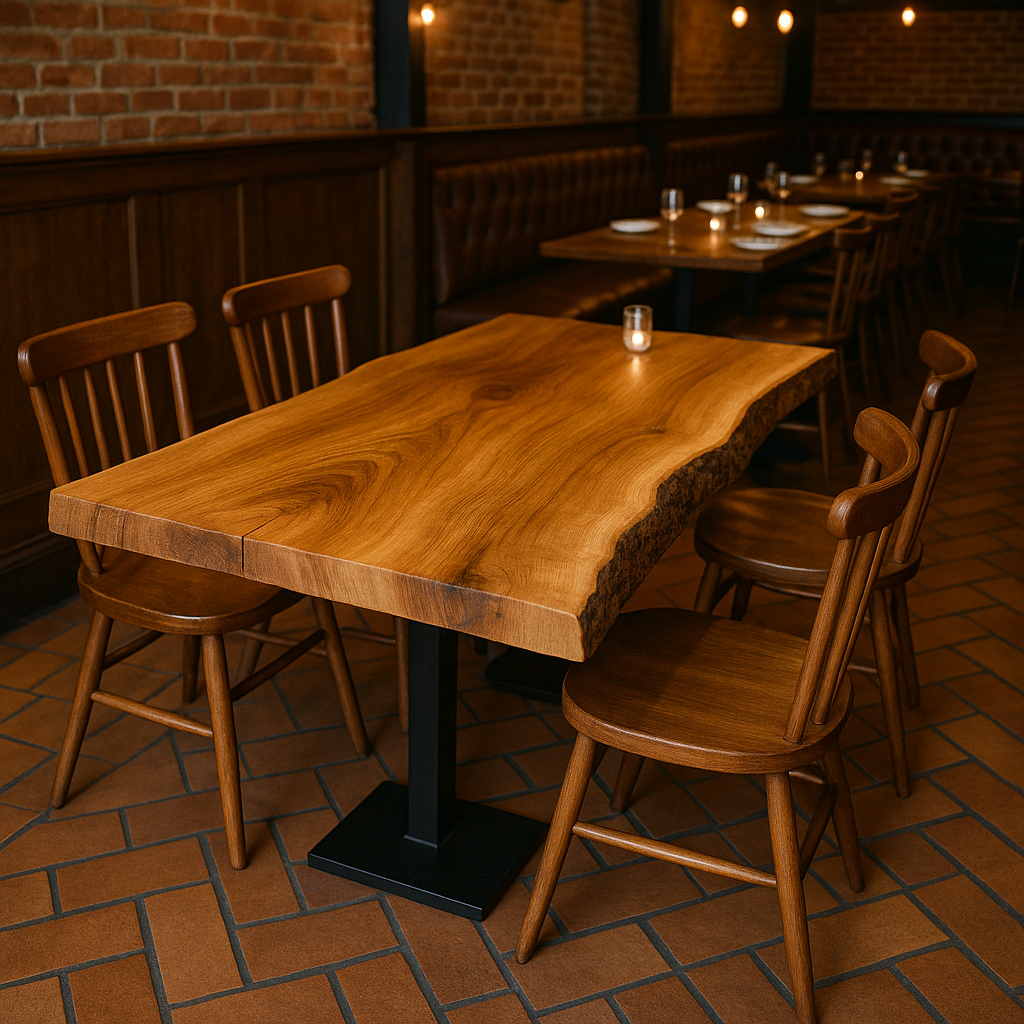
An AI photo of a custom edge table in a restaurant.
Pro Tip: Always confirm future batch consistency in writing if you’re sourcing tables in phases.
Why does consistency matter when reordering commercial tables?
Consistency across batches, reorders, and sites is essential in multi-site operations. A table that performs well in one location should match exactly when rolled out at scale.
Even subtle inconsistencies such as changes in surface sheen, colour tone, or hardware fitting can cause:
User dissatisfaction
Misalignment in visual standards
Functional mismatch in height or balance
ISO-aligned manufacturing and strict specification lock-in help reduce batch variance. Predictable quality supports visual harmony and functional repeatability across all locations.
What does low-maintenance table design really involve?
Low-maintenance tables do more than resist wear. They reduce the facilities workload, allow for predictable cleaning schedules, and minimise reactive repairs.
Look for tables that:
Tolerate commercial-grade cleaning agents
Require minimal tightening or adjustment
Maintain appearance over time
Fit easily into existing maintenance workflows
Predictable upkeep allows facilities teams to plan cleaning and inspections rather than react to sudden failures.
Custom Tables Built for Commercial Use
Built to spec, built to last. Get durable, design-led tables for your business with full trade support.
Get a QuoteWhat role does repairability play in long-term asset value?
Repairability is a key factor in sustainable procurement. In large estates, full unit replacement is rarely viable for every failure. The ability to replace damaged components such as tops or legs transforms disruption into manageable maintenance.
Modular commercial furniture supports:
Longer asset lifespans
Spare part sourcing
Simpler maintenance routines
Waste reduction
Alignment with sustainability reporting targets
Repairability lowers lifecycle cost and supports sustainability goals without relying on vague environmental claims.
Why is safety a procurement issue, not just a compliance one?
Safety is essential in public and high-traffic environments. When a table collapses or tips, the focus shifts to procurement documentation and standards.
Tables must meet stability and load requirements under guidance from bodies such as the Health and Safety Executive and BIFMA. For instance:
BIFMA X5.5 recommends a 750 Newton static load test for commercial tabletops
HSE looks for evidence of load ratings and tipping resistance
Procuring tables with verified test results and documented specifications supports safer outcomes and legal defensibility.
How does standardisation reduce operational friction?
Standardising tables across an estate simplifies logistics and operations. A consistent specification:
Reduces training time
Simplifies stocking of spare parts
Enables easier room reconfigurations
This approach promotes efficiency and reduces cognitive load for staff across maintenance, cleaning, and setup teams. For example, in hospital environments, standardised tables allow quick room reconfiguration without requiring new training or tools.
When might standardisation not be the right choice?
Some environments such as heritage spaces, research labs, or design-focused public areas may require flexibility in furniture choices.
In such cases:
Define clear exceptions within a broader framework
Document where and why custom specifications apply
Balance operational ease with special context requirements
How should value be measured in table procurement?
Short-term price savings often lead to long-term costs. To properly assess value, procurement teams should consider:
Lifecycle cost over five to ten years
Frequency of replacement
Cost and time of repairs
Downtime from furniture failures
For example, a table that costs £250 and lasts ten years with minimal maintenance outperforms a £150 table that needs replacing every three years. Tables that are durable, repairable, and consistent deliver better long-term value than lower-priced, higher-maintenance options.
Well-suited to this kind of value-focused approach are workshops like Tablemaker, who specialise in fully custom, trade-built tables for commercial interiors. Their hands-on approach, wide range of finishes, and direct coordination with project teams allow organisations to maintain quality control from design through delivery.
What should you ask suppliers before committing?
A strong procurement outcome starts with supplier clarity. Ask:
Can you guarantee consistency across all batches?
Are durability and safety test results available in writing?
Do you support modular repairs with spare parts?
Will product specifications remain stable over time?
Are your products tested to ISO, BIFMA, or equivalent standards?
These questions help align expectations and avoid surprises during rollouts.
Risk Assessment Checklist: Is Your Current Furniture Fit for Scale?
Are the same models used across all sites?
Do you have documented batch specifications and consistency records?
Can key parts be replaced without full disposal?
Are all tables certified to relevant durability and safety standards?
Is maintenance frequency known and planned?
Has lifecycle cost been evaluated per table model?
Two or more “no” answers may signal the need for a replacement strategy.
Conclusion: A Decision Framework That Scales
When replacing tables at scale, seven key criteria help facility managers and procurement teams make clear, defensible decisions:
Proven Durability
Batch and Reorder Consistency
Low Maintenance
Repairability
Safety and Load Performance
Standardisation
Long-Term Value
This framework reduces risk, promotes operational efficiency, and supports smarter commercial table procurement.
Upgrade to Made-to-Measure Tables
Avoid the hidden costs of off-the-shelf tables. Our custom builds match your exact needs and finish preferences.
Start Your Project
Tablemaker
55 High St, London N8 7QB
02083416334
HVQM+58 London