

Solid Oak Table Top Cut to Size UK: What to Send for a Quote
What information should you provide to get an accurate quote for a solid oak table top cut to size in the UK?
To receive a precise quote for a made-to-measure solid oak table top in the UK, you will need to provide detailed information about dimensions, intended use, mounting method, edge and corner preferences, finish, and any site-specific constraints. This enables the workshop to assess material needs, construction approach and compatibility with your space or base.
Table of Contents
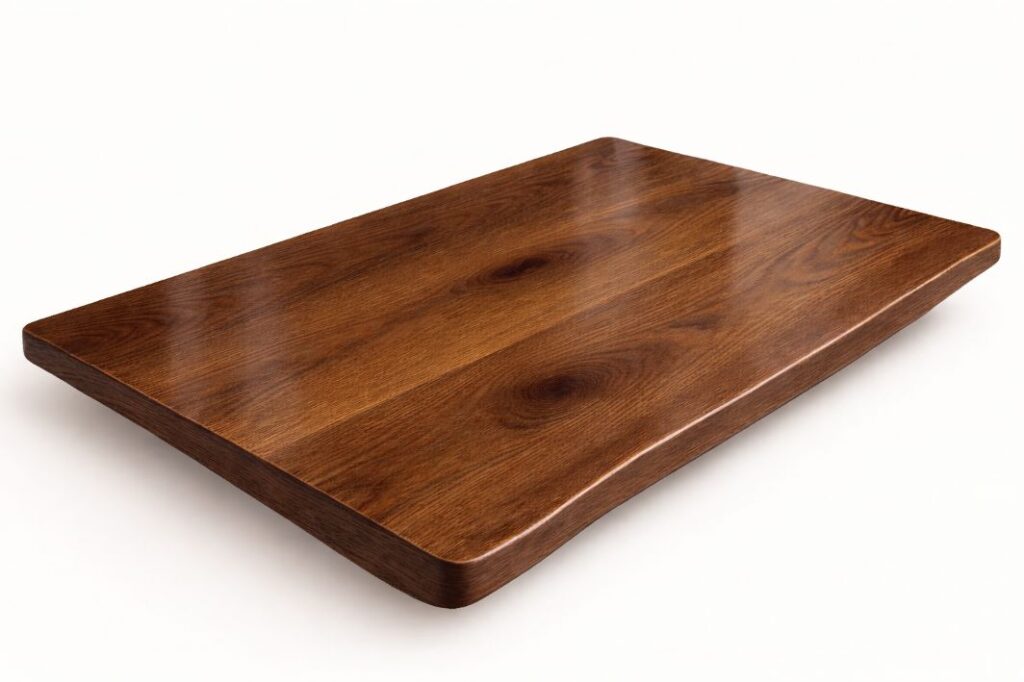
Why Accurate Information Matters Before Requesting a Quote
Getting a custom oak table top made to size involves more than choosing dimensions. From a workshop’s perspective, clear details at the outset make every stage smoother, from quoting to production.
For example, consider two quote requests:
- Enquiry A: “Looking for a desk top around 140cm. Can you quote?”
- Enquiry B: “Looking for a solid oak desk top, 140cm wide, 70cm deep, 27mm thick, for a sit-stand frame, rounded corners preferred, natural finish, fixing via brackets.”
Enquiry B allows the workshop to give a meaningful quote quickly, including fitting considerations, delivery estimation and suitable finishing. Enquiry A will likely need a follow-up request for more information, which delays the process.
Providing clear and specific details reduces ambiguity, improves accuracy and avoids unnecessary back-and-forth.
Dimensions: What to Measure and How to Present It
Dimensions directly influence production feasibility, fit and cost. Precise measurements are important, especially when fitting to an existing frame or into a defined space.
When measuring:
- Width and depth: Always provide the finished size required, measured in millimetres. This avoids confusion and ensures alignment with workshop standards.
- Thickness: Typical thicknesses in UK workshops range from 25mm to 40mm. Thicker tops may be heavier and more expensive, but also offer greater rigidity.
- Space allowance: If fitting between walls or within a recess, allow for clearance. A snug fit sounds ideal but can lead to swelling issues if timber expands.
- Non-square shapes: For angled spaces or cut-outs, include a sketch with labelled dimensions.
- Frame compatibility: If the top must align with a specific frame, measure fixing bracket positions if relevant.
Using metric units helps maintain consistency with most UK-based joinery workshops.
Pro Tip: For snug-fitting areas, subtract 3 to 5 mm from your exact wall-to-wall measurement to allow for wood movement.
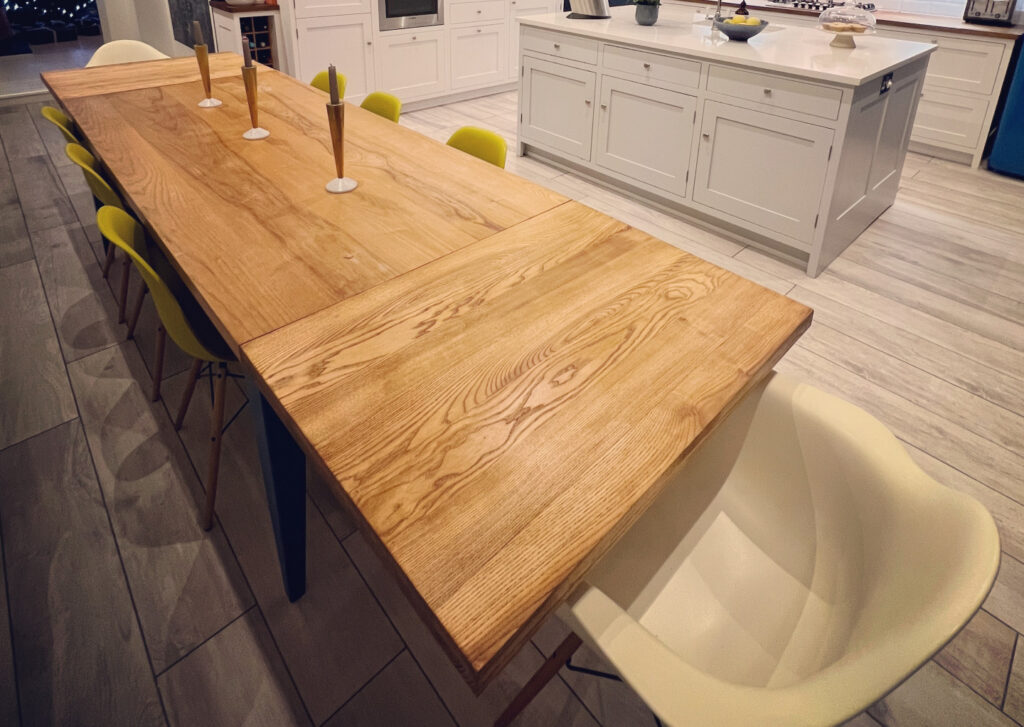
Pro Tip: When matching to an existing desk frame, photograph the underside to show bracket layout and avoid misalignment.
Intended Use: Dining, Desk, Commercial or Other
How a table top will be used directly affects construction decisions. Material finishing, joint strength and reinforcement placement can all vary depending on intended function.
Typical scenarios include:
- Dining tables: These usually require food-safe finishes with strong surface protection against heat and moisture. Rounded corners may be preferred for comfort and safety.
- Desks (home or office): May need cable allowance, monitor risers or a satin finish that reduces glare. Sit-stand compatibility also affects bar placement.
- Commercial settings: Tops for cafés or restaurants often need additional reinforcement due to high turnover use. Durability and ease of maintenance are key.
- Multi-use or shared desks: These may require dual cable channels or modified edge cuts for adjacent seating.
Knowing the use case allows the maker to recommend features that improve longevity and practicality.
Mounting Plans: How the Top Will Be Fixed or Supported
How your table top will be secured matters just as much as its size or timber type. Proper mounting influences both structural integrity and aesthetic outcome.
You should consider and communicate:
- Type of base: Is it a fixed frame, a modular desk, trestles or a sit-stand mechanism? Include brand, if available, especially for sit-stand frames.
- Fixing method: Will you screw directly in, use brackets, or keep the top floating? Each method has implications for movement allowance and cupping resistance.
- Straightening bars: Most solid wood tops include internal or underside bars to counteract warping. Their placement may be adjusted depending on fixing plans.
- Undrilled preference: Many workshops, including Tablemaker, supply tops undrilled to let customers align holes precisely to their base. Pre-drilling is possible but should be based on accurate specifications.
Mounting should be taken seriously during planning, not treated as an afterthought.
Request a Custom Solid Oak Quote
Send your dimensions and preferences to receive a precise quote for a made-to-measure solid oak table top.
Get Your QuoteEdge Profile and Corner Preferences
Edge and corner specifications impact visual impression, touch sensation and even safety, especially in households with young children or tight walkways.
Common options include:
- Edge profiles:
- Square: Clean and simple, with sharp lines.
- Chamfered: Lightly angled for a softened modern edge.
- Rounded: Smooth edge that feels softer to the hand.
- Corner radius:
- Minimal radius: Suits formal dining or rectangular aesthetics.
- Softened corners: Practical for smaller spaces or child-friendly environments.
To specify your preference, you might describe it as “soft profile with rounded corners” or “sharp minimal lines with defined edges.” You do not need to use technical terminology, and plain requests work well when paired with photos or references.
If uncertain, you may request a quick sample or drawing to clarify edge feel.
Finish Type and Colour Preferences
The finish applied to a solid oak top does more than affect appearance. It influences protection, durability and ease of maintenance.
Most UK workshops use hardwax oil as a standard choice due to its practical benefits. This type of finish penetrates the wood while providing a smooth surface that is resistant to spills and heat. It also allows for refinishing over time without needing to replace the whole piece.
When choosing:
- Colour:
- Natural: Keeps the original tone of the oak, showing the grain fully.
- Tinted: Available in light, mid or dark tones. Useful for matching to floors or existing furniture.
- Finish sheen:
- Matte: Low gloss, understated feel.
- Satin: Slight sheen, offers a subtle lift without looking polished.
If colour matching is important, request a small finished sample in your preferred tone.
Any Constraints, Challenges or Special Requests
Unusual situations are common in furniture projects. Sharing them early helps the maker accommodate constraints without need for costly revisions.
Consider mentioning:
- Fitted spaces: e.g. Between fixed walls or under a window sill
- Cable needs: e.g. Pre-drilled cable holes or grommet placement
- Base quirks: e.g. Fixed metal base that limits bracket positions
- Shared use: e.g. Table shared by two workstations
- Visual concerns: e.g. Matching an existing leg colour or aligning with nearby furniture
You do not need to send perfect drawings. A phone photo with handwritten notes is often enough to provide context. Sketches are welcome if angles or curves are involved.
Clear communication of these aspects helps produce a top that does not just fit but functions practically in your space.
Speak with a Woodwork Specialist
Unsure about your measurements or finish options? Our specialist team is here to guide your custom order.
Contact a Specialist
Tablemaker
55 High St, London N8 7QB
02083416334
HVQM+58 London